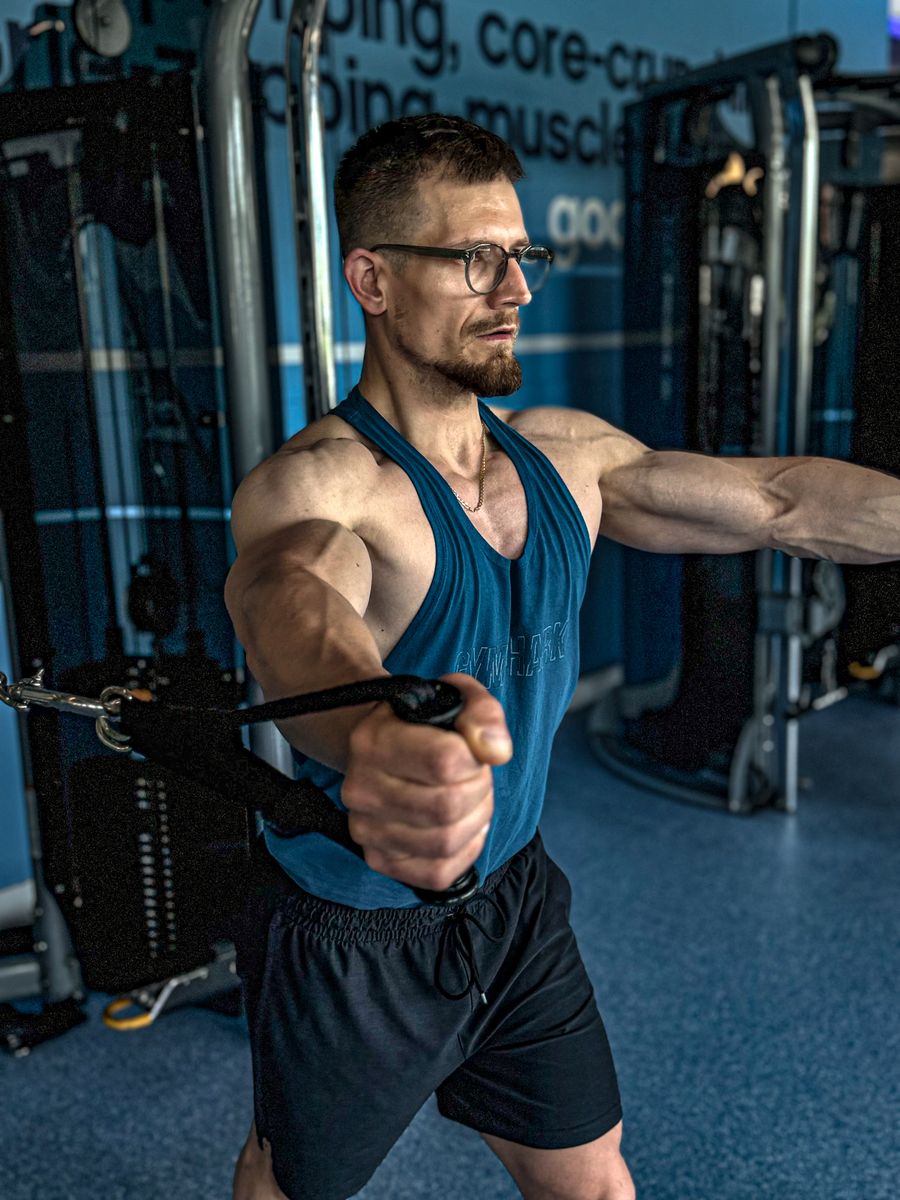
If you've never trained properly, you're about to have the best twelve months of progress of your entire life. Beginners respond to lifting like nothing else — strength jumps weekly, muscle shows up in months, and it happens with far less volume than experienced lifters need. The only way to waste it is to copy a bodybuilder's programme off YouTube and burn out by week three.
This is the beginner's version we use at Atypical: what to do, how often, what to eat, and what to expect month by month.
THE THREE THINGS MUSCLE NEEDS
Muscle growth (hypertrophy) requires three things: mechanical tension (lifting weights that challenge you), adequate nutrition (enough calories and protein to build new tissue), and recovery (sleep and rest days for repair). Miss any one of these and progress stalls.
TRAINING: SIMPLE, HEAVY-ISH, PROGRESSIVE
Frequency: 3–4 sessions per week. As a beginner, your muscles recover quickly. Three full-body sessions or four upper/lower sessions per week is optimal. More isn't better at this stage — you need recovery time between sessions for muscle repair and growth.
Exercise selection: compound movements first. Squats, deadlifts, bench press, overhead press, rows, pull-ups (or lat pulldowns). These multi-joint exercises work the most muscle in the least time and build the strength foundation everything else depends on. Add isolation work (bicep curls, tricep pushdowns, lateral raises) after your compounds.
Sets and reps: 3–4 sets of 8–12 reps. This is the hypertrophy sweet spot for beginners. Choose a weight that challenges you by rep 8–10 but allows you to complete all reps with good form. When you can comfortably hit 12 reps with perfect technique, increase the weight by 2.5–5kg.
Progressive overload. This is the single most important principle. Your body only builds muscle when it's challenged beyond what it's used to. Every week, aim to do slightly more — one extra rep, a small weight increase, an additional set. Without progression, your body has no reason to adapt. Our 1-to-1 training programmes this automatically.
EATING: MORE THAN YOU THINK
Calorie surplus (for muscle gain). To build muscle optimally, you need to eat slightly more than your body burns — a surplus of 200–300 calories per day. This provides the raw materials for new muscle tissue. If you're also carrying excess fat, you can build muscle at maintenance calories or even a slight deficit (beginners are uniquely capable of this).
Protein: 1.6–2.2g per kg of bodyweight. Non-negotiable. Protein provides the amino acids that literally build muscle tissue. For a 75kg person, that's 120–165g of protein daily. Spread across 3–4 meals for optimal absorption. Good sources: chicken, fish, eggs, dairy, whey protein, tofu, legumes. See our full nutrition guide.
Carbs for energy. Carbs fuel your training sessions. If you're trying to build muscle, don't cut carbs — they're your performance fuel. Rice, potatoes, oats, bread, pasta — all fine.
RECOVERY: WHERE THE GROWTH HAPPENS
Sleep 7–9 hours. Growth hormone is released during deep sleep. Muscle repair happens overnight. Consistently poor sleep can reduce muscle protein synthesis by up to 18%. This isn't optional — sleep is when your body actually builds the muscle.
Rest days matter. Muscles grow during recovery, not during training. Training breaks muscle down; rest builds it back stronger. Take 1–2 full rest days per week. Light walking or stretching on rest days is fine — just avoid intense training.
WHAT THE FIRST YEAR LOOKS LIKE
Month 1: Primarily neurological adaptation — you'll get stronger quickly but visible muscle changes are minimal. Your body is learning the movement patterns.
Month 2–3: First visible changes. Shoulders look broader, arms have more definition, posture improves. Others may start noticing.
Month 4–6: Significant visible muscle growth. Clothes fit differently. Strength has increased substantially. This is where most people become genuinely hooked.
Month 6–12: Dramatic transformation. A beginner following a proper programme can gain 5–10kg of muscle in their first year. After that, gains slow to 2–4kg per year.
The quickest way to get all of this right from day one is to have someone coach the lifts and write the progression for you. That's the one-to-one option at the studio — and the first session is free.